
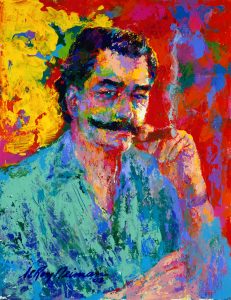
Now in his ninth decade, the hugely popular artist LeRoy Neiman doesn’t get into his studio as much. His ubiquitous long black Monte Cristo cigars rarely touch his lips, and the once globally recognized handlebar mustache has turned gray.
Born in St. Paul, Minn., the artist has referred to himself as a “street kid.” As a parochial school student, he spent most of his time in class drawing and sketching, but was fortunate to find that it earned him special treatment. After winning an art contest in sixth grade, Neiman soon began earning money by creating artwork for local merchants. He left school in 1942 to join the U.S. Army but returned after the war to earn his high school diploma.
He went on to study at the University of Chicago and the University of Illinois, as well as at the Art Institute of Chicago, where he later taught. Early in the 1950s, he was a freelance fashion illustrator for Carson Pirie Scott & Co., where he met Playboy founder Hugh Hefner and ultimately became the magazine’s primary artist. By the 1960s, Neiman set up studios in London and Paris and ultimately, overlooking Central Park in New York, where he now lives.
In LeRoy Neiman: Art and Life Style (1974), one of nine books about him and his work, the artist reaffirmed, “If nothing else, the army completely confirmed me as an artist. During this period, I made my crucial discovery of the differences between the lifestyles of an officer and a private first class. This was to become the basis of my later mission in art, to investigate life’s social strata from the workingman to the multimillionaire. I discovered that while the poor I knew so well are so often pitiable, the rich can be fools.”
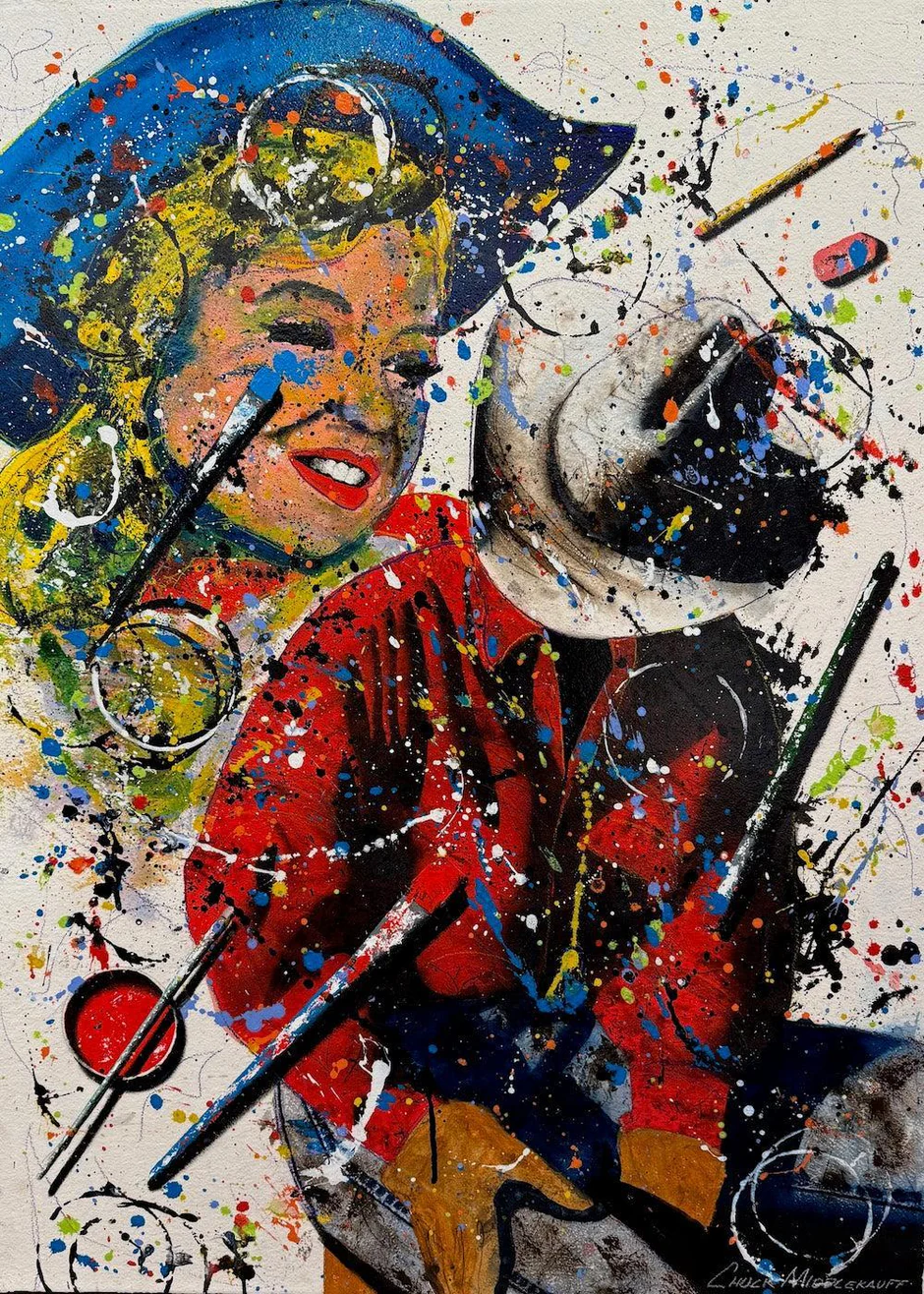
As for artistic muses, Neiman cites many of the greats, including da Vinci and Rubens, Raoul Dufy, Oskar Kokoschka, and George Bellows. He drew other inspiration from the Abstract Expressionists, in particular Jackson Pollock and the “action painters” who experimented with flinging, splattering, and dribbling paint.
One day in 1953, he came upon several partially used cans of enamel paint. As he experimented with the offbeat medium, he found it very workable and ultimately created an image titled “Idle Boats”, which subsequently won first prize at the “Twin City Show.”
The Minneapolis Institute of Art purchased that painting, making it his first work acquired by a museum. That same year, he also had solo shows at galleries in Chicago and Lincoln, Ill. In 1956, he was listed in Art in America magazine’s “New Talent in America.” Then in 1957, one of his paintings was included in the American 25th Biennial Exhibition at the Corcoran Gallery of Art in Washington, D.C.
Widely known for his vividly colored, energetic, and flashy imagery of sporting events and “the good life,” Neiman was once as recognizable to audiences as the athletes and personalities he depicted. He could be spotted in box seats at major championship matches, rubbing elbows with the VIPs and dignitaries, palling around with the likes of Ali, Sinatra, Salvador Dali, Andy Warhol, with whom he had a two-man show in 1981, and even Sylvester Stallone. Neiman has credits in Rocky II, III, IV, and V, where he either appeared in a cameo role or his art was used as a set decoration. Neiman mingled and hobnobbed with so many famous people, too numerous to mention here, but it’s a safe bet those celebs shared a similar comfort level with him.
The instantly identifiable Neiman painting style is familiar to a remarkably broad range of people, many of whom first encountered his art in the pages of Playboy magazine. But his acclaim is much wider. He was the official artist at five Olympiads, millions watched him sketching on TV during the Olympics, the Super Bowl, Churchill Downs, a Grand Prix race, tennis tournaments, and even the 1972 world championship chess match between Bobby Fisher and Boris Spassky.
Neiman’s talent and persona were a perfect fit for ABC Television’s Wide World of Sports. As such, he was present alongside Jim McKay, Howard Cosell, and Peter Jennings during the infamous Munich Olympics and thus became a witness to the horrific massacre of Israeli athletes. The resulting images from that year’s Olympiad were later exhibited in the Indianapolis Museum of Art.
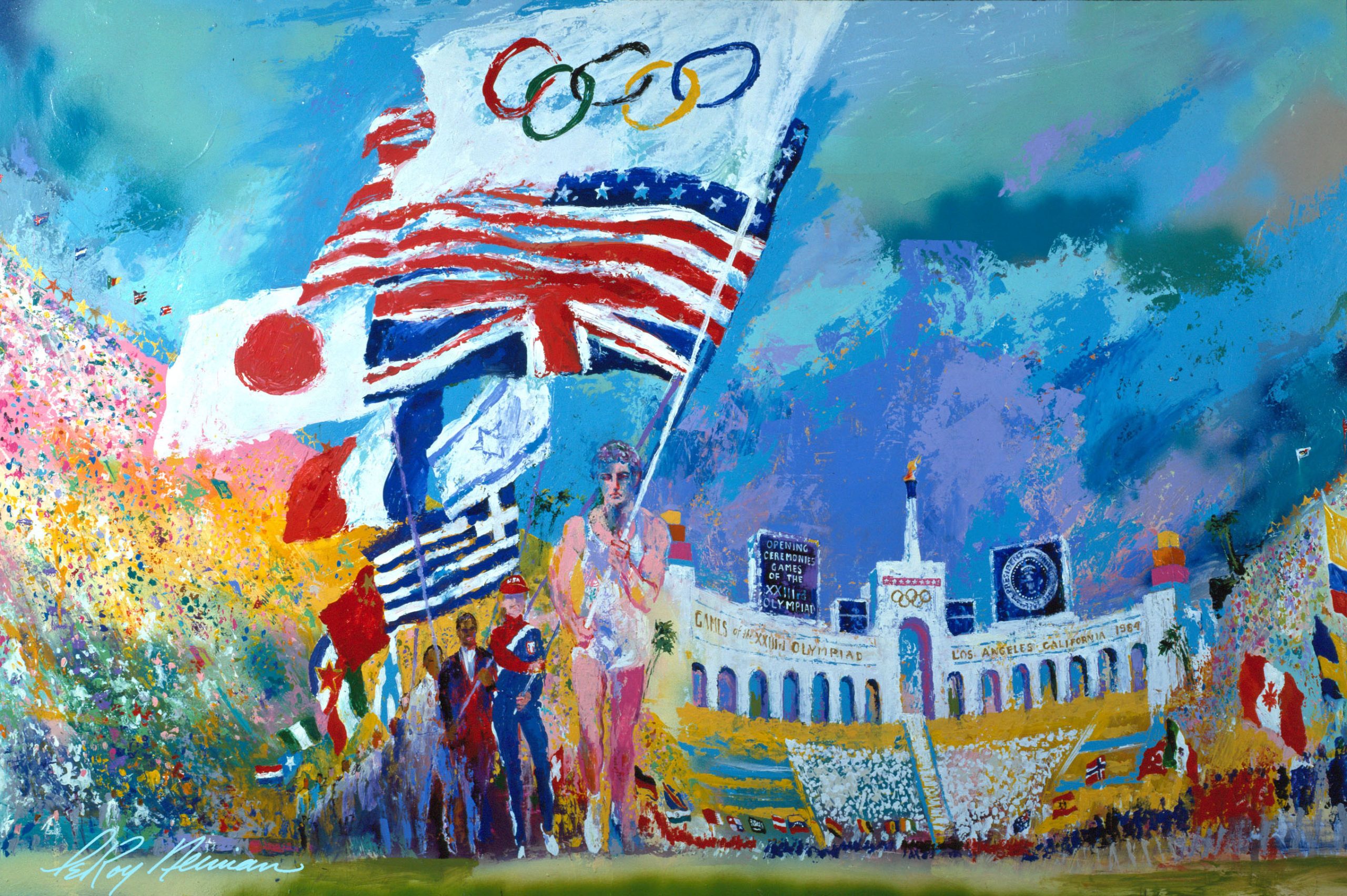
The cover of this issue of Arts Perspective depicts Neiman’s rendition of the opening ceremony of the 1984 Olympics. It is a positive reflection of the festive atmosphere surrounding the parade of multinational flags and athletes.
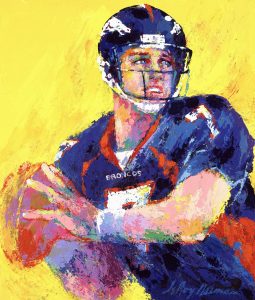
John Elway, 1999
For Bronco fans, particularly, Neiman’s portrait of “Quarterback John Elway”, painted in 1999, the year the star retired, captures his likeness without histrionics, but with a reverence worthy of the two-time Super Bowl champion, MVP, and Hall of Famer.
In his book from Lyons Press, All Told – My Art and Life among Athletes, Playboys, Bunnies, and Provocateurs, Neiman reflects on his life and on the world around him, and on the famous people he met. It is a wonderful account of a life well lived; fascinating, fast-paced, and every bit as extraordinary as the events he visually recorded.
In the candid memoir, Neiman even talks about his iconic mustache, which readers will discover has a charming connection to the wife of Salvador Dalí.
“I’m a storyteller,” he declares. “Only I tell my stories in a riot of color. Painters have always told stories — martyrdoms, murders, battles, saints, and sinners — and that’s still what I do … I paint superheroes, like the Olympians who daily perform supernatural feats, things we could never do, even with unlimited years of practice.”
While sports themes may seem to dominate his work, Neiman is also a reporter of the “good life.” In 1958, he was given an assignment by Playboy magazine to create a series titled “Man at his Leisure,” and being as gifted with words as a paint brush, Neiman also wrote the text for the body of work. Traveling throughout Europe to cover elite social and sporting events, the artist’s keen eyes and skilled hands gave birth to bold, flamboyant artistic renditions of such heady places as the Cannes Film Festival, the Folies Bergère, the running of the bulls in Pamplona, Steeplechase and motor races – a gamut of the exciting, fast-lane lifestyle in which he was right at home.
Incredibly, Neiman continues to work, and early last year, he did eleven charcoal drawings of J. Edgar Hoover, Eliot Ness, and the “folk hero” mobsters of his prohibition-era youth. He’s considering lending them to the recently opened Las Vegas Mob Museum.
When Arts Perspective asked him to choose among the hundreds of paintings from his illustrious career, he chose a current favorite, “Big Band” (13’x9’), completed in 2005. In it are 18 nearly life-size portraits of the great jazz stars from the 1950s to 1980s that he knew personally. It may well be a dynamic metaphor for Neiman’s life; musicians playing a tribute to the man who loved and lived it all while giving the world his unique perspective on the journey.