
Of course, the moon was full; could it possibly have happened any other way? Even inland, the tides pulled differently, and something in the body awoke.
I had recognized the house as soon as I saw it, though I’d never been there. I pushed down the part of me, realizing I had dreamed this, telling myself I had to have seen it in a magazine.
I walked up the eight red steps, then unlatched the delicate gate and stepped onto the porch. I fastened the latch, then turned to face a small, round table draped with dark purple lace. I sat down in one of the two chairs, aware of the drone of cicadas somewhere in the distance, and of this not being the season for them. The fragile seat, white and gold like an elegant woman’s dressing table, was comfortable, and I relaxed.
Closing my eyes, I breathed deeply, then started when I felt like the air I was inhaling was the color of celery.
An older woman was standing near me. Her blue jeans and denim shirt hung on her lank frame, her thinness belying the exuberant health that surged through her, in the tilt of her head, in the easy, complete way she breathed, in the set of the silver glasses on her nose. Her brilliantly white hair was cut short as a man’s, incredibly exotic, paired with the chandelier earrings that danced nearly to her shoulders. She was crusted with jewelry — black obsidian bead bracelets, loose on both her wrists, tiny silver circles around her toes, the nails painted bright metallic turquoise. I knew she wore a necklace under her shirt, against her skin. I longed to see it, to feel its warmth.
“Tea?” she asked.
“Coffee,” I replied.
“No,” she said, and I could only stare as she turned to go inside. A most peculiar waitress, but it was somehow all right.
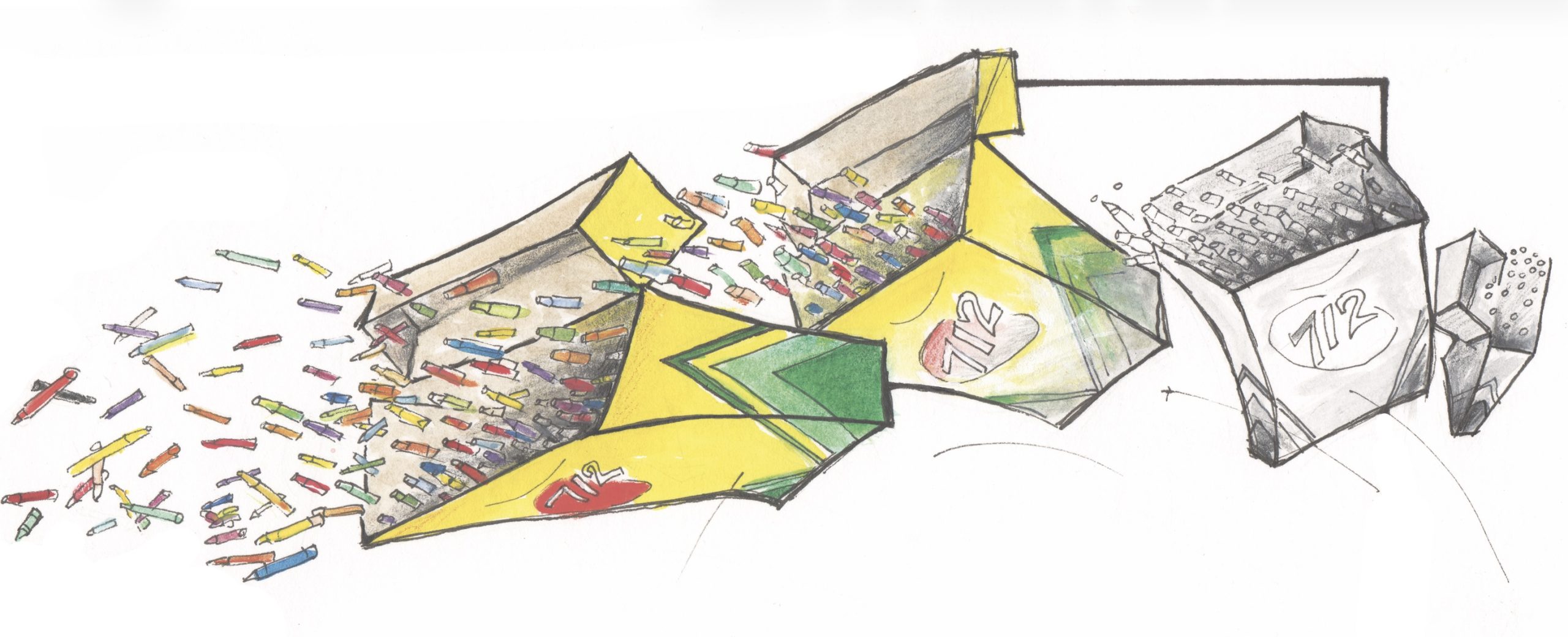
She returned in an instant with white linen placemats and white linen napkins. The silverware she put at each of the two settings was completely mismatched. Nearest me, she carefully placed three salad forks and a baby spoon; opposite me, she placed a butter knife, an iced teaspoon, and another baby spoon. In the center of the table, she put a covered basket, steam rising from it. Cornbread, from the smell of it. She returned with red-gold honey in a vinegar cruet, a Royal Albert sugar bowl swimming with melted butter, and the largest box of crayons I had ever seen. She returned a third time with clear wine glasses, faintly blue, and a huge white pot with a screw-on lid, like you see in restaurants.
When she sat down opposite me, I was not surprised.
The sun glinted on the tiny gold and pearl nautilus pin she wore on her shirt collar as she poured. The tea was a swirl of blueberry blue and strawberry red–it smelled like a hot evening in a Mediterranean country five centuries ago.
“It’s good with honey,” she said, pouring five drops into her own goblet, which immediately bloomed gold. Instead, I uncovered the basket to get at the bread. The steaming corn muffins had been made with Hopi red cornmeal, and I felt faintly sick. There was too much color. I took one and broke it open, inhaling the steam that brought my grandmother back to me. The woman pushed the bowl of butter toward me, so I dipped the smallest piece and ate it. I chewed slowly, aware that this was the best thing I had ever tasted in my life. It was the butter—I could have drunk it all.
“Everything tastes this good,” she said, “when you are present in the moment.”
“Mmm,” I agreed.
“Drink your tea,” she told me.
“No,” I said, “I won’t.” It’ll make me sick, I thought. The sweetness, the richness, the color — it was overwhelming. And tacky. I could feel each chew of the butter-drenched cornbread glide down my esophagus, unerringly headed into my stomach. Please, I thought, don’t let me feel it go in.
“What took you so long?” the woman said.
“Oh, the traffic,” I said flippantly. What a silly question, as though she could have been expecting me.
“I’d begun to worry, Monique.”
“That’s not my name.”
“It is here,” she said quickly.
“And your name,” I said condescendingly, “is Fontana.”
“No,” she said. “It’s Anrelina.”
“Isn’t there a song about the dancing Anrelina?” I asked. I was making that up. I’d never heard of that name before. It sounded like someone who would collect tiny colored bottles. Monique is someone who would have a fluffy white powder puff. I don’t.
“Take the letter out of your pocket,” she said. “Spread it out here on the table.”
“No,” I said. How did she know I had a letter? I wasn’t about to show it to her. I’d written it myself, to myself, pretending I was this man whom I desperately wanted to notice me, writing sweet nothings to me. It was so beautiful I wept every time I read it.
“Oh, come on. To be alive is to take risks.” She patted the table near the unopened box of crayons. “I’ve written letters to myself before.”
“How lovely,” I said. “That tea is making me sick. I’d really prefer coffee.”
“I’m offering you gold and you want sand.” She shrugged. “Very well. It’s already ready. I knew you’d insist.” With a sigh, she stood up, soon returning with a quart-sized disposable cup, lidded, and put it beside me. Contrarily, I pulled off the lid, inhaled the aroma (Kona!), and poured some into my goblet. One sip, and immediately I felt better grounded.
“The letter,” Anrelina said, dipping cornbread into the melted butter. “That’s non-negotiable.”
“No,” I said. “It’s none of your business.”
“I’d very much like to see it,” she said, “especially since you mailed it to yourself. That’s very significant.”
“It’s time to go,” I said, pushing away from the table. I kept a firm hand on the coffee; I’d take that with me.
“Funny,” she said, watching me. “I didn’t figure you for a coward.”
“Just what did you figure me for?”
“Monique, Monique. Sit down and take out the letter. I’m not going to read it. The envelope will suffice.” She pointed to the ridiculous chair I’d been sitting in. “You haven’t finished your cornbread.”
“There’s too much color,” I said, easing down onto the white cushion. “It’s making me queasy.”
“The world is not black and white. Close your eyes and eat another corn muffin while I neaten the table.” She handed me the breadbasket, then set it in front of me when I didn’t take it.
When she left to take the teapot inside, I found a yellow corn muffin at the very bottom of the basket. Now that looked more like food. I ate it slowly, eyes shut as she suggested and saw a Ferris wheel that turned into a whirling kaleidoscope. The colors were black and bright green.
I opened my eyes. Again, Anrelina was sitting across from me. She’d painted her upper lip cherry red and her lower one aubergine. I felt nausea in the back of my throat. Her hands, flat on the table, were heavy with rings. On one thumb was a blue topaz as big as a robin’s egg. She wore emeralds, rubies, lapis, moonstones, and carnelian. I looked down, grateful for the sanity of my black skirt. I swallowed heavily, awkwardly.
“The letter,” she said, smiling brightly like a bad dream.
I slowly removed it from my purse and placed it on the table. “If you touch it, I will scoop out both your eyes.” I put the baby spoon atop the envelope.
“My cherished Monique,” she began. “I close my eyes and think of you. I stand in the shower and think of you. I drive my car and think of you. I study my face in the mirror and think of you. I evacuate my bowels and think of you. I trim my toenails and think of you. I kiss my pillow and think of you.”
“Not even close,” I said smugly.
“Your hair is like a raven’s wing,” she continued, looking straight at me. “Your eyes are as blue as the sky. Your lips are like cherries, and your teeth are like pearls. Your tongue is like a snake. Your legs are like Greek columns. Your breasts are like two eggs. Your bottom is like a big fat pillow.”
“If you were my lover,” I said calmly, “I would fire you.”
“It’s no sillier than what you have written to yourself. I wish you had partaken of the tea; it would have made things so much easier.”
“I’d rather take the hard way,” I said, just to be contrary.
Wind chimes sounded. A mockingbird trilled like a song sparrow, then quacked. Enormous turquoise pots on the inside of the porch railing were filled with lavender in bloom, Johnson’s blue geraniums, and tiny, deeply purple-blue lobelia. Mauve wave petunias frothed from five hanging pots, and now in the breeze I caught the cloying, clovey headiness of stargazer lilies. It was all too much. It was exhausting. I would have to have my eyes examined when I got home.
“What you need is David Phlox. The pure white. That’s all,” I said firmly.
“White is the presence of all colors,” she said.
“I’d like to slap you,” I said, and took a sip of the coffee. It was cooling fast.
Quickly, she snatched the baby spoon off the envelope and stuck it behind her right ear. The envelope lay bare, exposing the pitiful little prismatic heart stickers I’d put on its flap. “Pick a color, any color,” she said mechanically, gesturing with her head toward the box of crayons.
I picked it up. Seven hundred and twelve different colors, I read. Hardly, I thought. It put into mind those Harry Potter jellybeans that came in flavors like earwax and vomit. Gingerly, I pushed back the top, sure I’d find colors inside like rot, flyblow, and soiled cat litter.
“Don’t look,” she said. “Choose with something besides your eyes.”
“My elbow? My ear? My vermiform appendix?” I asked, but obediently closed my eyes and ran my fingertips across the waxy cylinders. Is there anyone alive who doesn’t love the smell of new crayons? I settled on one and pulled it out, opening my eyes.
It was white, then barely pink, then barely violet, then white again. “Lotus,” I read on the wrapper. “What kind of dumb color is lotus?”
“I don’t know. What kind is it?”
I ignored her and pulled another crayon from the box. The color was swirling and ever-changing, like that old Apple screen saver called Samadhi.
“Kaleidoscope,” I read. “That is nothing like a kaleidoscope.” I dropped it on the table.
When I reached for another, she put her hand over mine. “You are greedy,” she observed.
I shrugged. “Toys,” I said, as though that explained something.
She handed me the lotus crayon. “Draw a line on the envelope,” she said.
“And mess it up?”
“You can always write yourself another.”
Bossy old woman. “I could always break your precious crayons.”
“Go ahead. You wouldn’t be the first to try.”
I snatched the stupid lotus crayon from her and signed my name, my real name, across the back of the envelope. Right over the heart.
“Do you always make things so hard on yourself?” I heard her voice from very far away as I fell slowly, slowly into the ocean coursing throughout my envelope.
I stretched, grinding grit into the backs of my bare legs. My body felt so rested. A breeze tickled across my belly.
Startled, I sat up quickly, heart pounding. The night was late; a big yellow moon hung straight in front of me, its reflection rippling a glowing pathway across the waters that rhythmically moved in and out, in and out, toward me and away from me, toward me and away from me. I wore only my underwear —my beige cotton bra, slightly pilling in the cups —and my low-cut boy-leg panties, white with tiny purple flowers. I was bloated beneath my belly button, like I’d overeaten.
Even in the darkness, I could see everything: the sky’s deep indigo, the teal of the shallow waters, the white sand littered with tiny pink and yellow spirals, the brilliant emerald of the leathery palm fronds behind me.
As far as I could tell, as far as I could see, I was alone.
I put my hand on the spot I think of as my heart. Not long ago, I was at a retreat where, every morning at breakfast, a beautiful black woman from Martinique rubbed my heart. It had been like an angel touching me, and I never knew why she did it–I don’t think she did, either. I missed it. Right now, I very much want Marlena to rub my heart. I thought of her as I massaged myself and was comforted.
My breathing slowly calmed. The air I was inhaling was the color of lemons. Avocados. Watermelons.
I stood up, feeling self-conscious and ridiculous in my underwear. My feet felt so heavy, and I dragged them and myself toward the surf. The water would feel so good. The blue-green water foamed and frothed; I could taste its salty seaweed flavor…
Anrelina pinched my nostrils shut and pulled my nose. I slapped her hand away, then quickly looked down at myself. Thank God, I had all my clothes on.
“You didn’t come back when I told you to,” she said.
“Who died and made you king?” I spoke.
“Queen,” she corrected me. “Or Empress.”
“Busybody, if you ask me,” I grumbled.
“Did you have sex?” she said.
“What kind of a question is that?”
“The kind of nosy old woman asks,” she laughed. “One would think taking a love letter to the seaside would result in–”
“Oh, shut up,” I said. “Just shut up.”
“Just trying to help.”
I wanted another cup of coffee, but I wasn’t about to ask her for one.
“I have to go,” I said.
“Have to or want to?”
“Both. Thank you very much,” I said, knowing I was about to lie. “It’s been a pleasure.”
“No,” she said. “It hasn’t.” She pushed the box of crayons toward me again. “Choose the color you’re most afraid of. Choose the color you would wear if you were without fear.”
“I’ve had enough of this,” I said, standing up.
“Look at you,” she said. “There’s no color anywhere at all about you. Even your eyes and your mouth are pale.”
“Tacky old woman,” I enunciated carefully. I picked up the box of 712 crayons and emptied them onto the porch.
“Excellent!” she said. “They’ll be waiting when you come back.”
“I won’t be back,” I said, already on the fourth red step.
We both knew I was lying.