
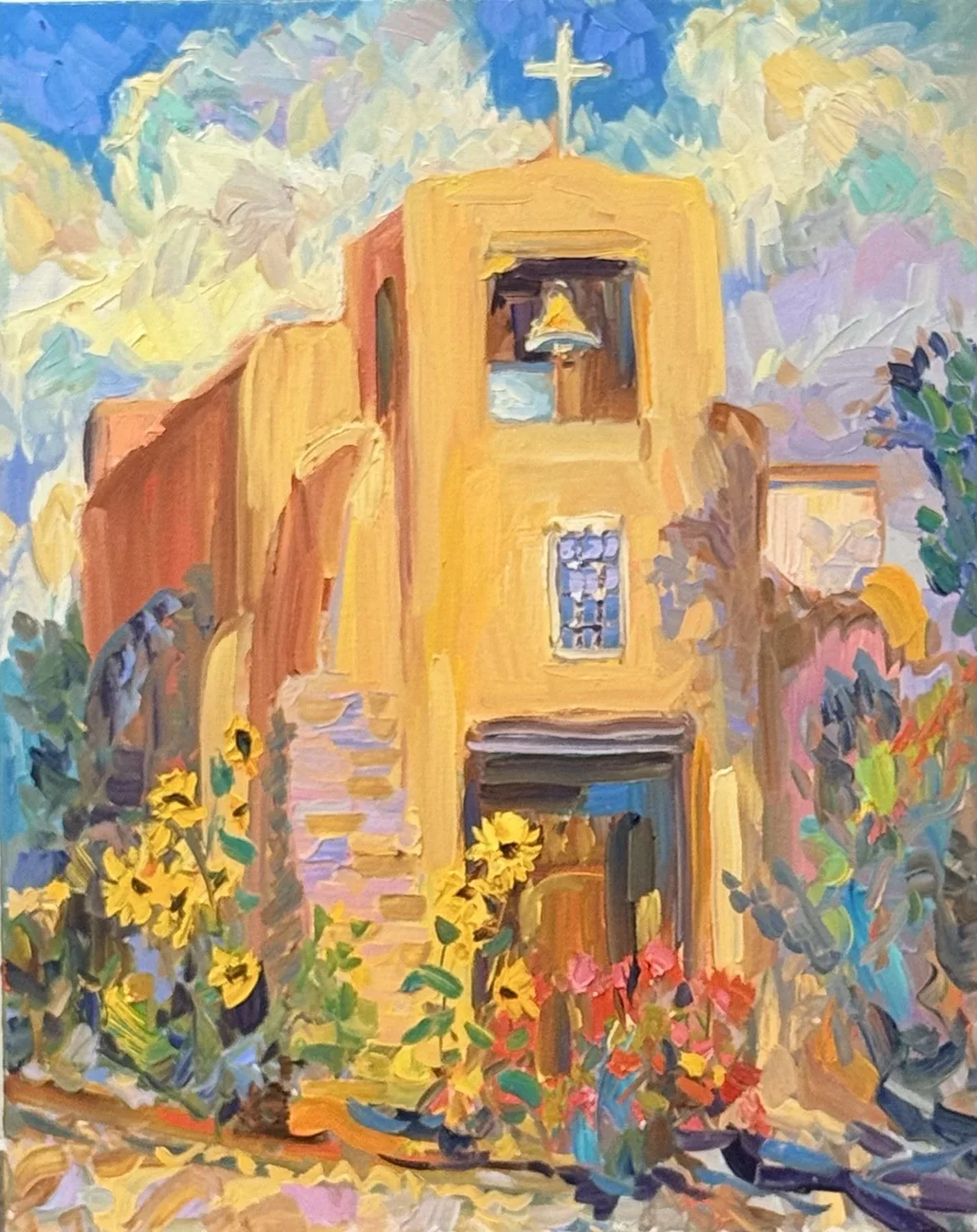
I remember the evening I first saw the bell on the plaza. The year was 1950 and the month was January. I had just turned six. I recall I was on my way to Our Lady of Guadalupe Church to deliver Father Francisco the supper my grandmother had prepared for him. The sun was setting, and the sky was aflame with streamers of crimson clouds. The snow on the Sangre de Cristo peaks looked like pink whipped cream. Walking, taking my time, wafts of roast chicken, beans and green chile from the village chimneys drifting in the breeze. Even now, I can see the bell sitting under the setting sun by the blue fountain facing the church, glittering like the Río that runs through San Miguel. It was the most beautiful thing I had ever seen.
Its discovery the next morning by the townspeople as they arrived for Sunday mass, caused a sensation. Holding onto my grandmother’s thin hand, made smooth by years of hard work, I watched as they expressed their amazement.
“Look at the size of that campana!,” they exclaimed. “It sparkles like gold!”
I recall my grandmother pushing me forward. “Go, get a good look, Leonardo.”
With a smile on my round face (everyone always told my grandmother I had a round face), I stood in front of the bell moving to and fro, tickled that my body ballooned when I leaned forward and narrowed when I leaned back. The bell glimmered and glimmered, winking at me. We shared a secret.
That week San Miguel was astir with talk of the bell. At first everyone thought Father Francisco had collected enough money during Sunday mass to replace the old bell that had been cracked by lightning. But he was as mystified as everyone else by its mysterious appearance. After inquiring at neighboring parishes to make certain none was missing a bell, Father Francisco lost no time in gathering volunteers to lift it up to the belfry. He told us in his rich, Castilian voice that the town of San Miguel had been blessed with a gift. My grandmother, who was very devout, simply believed the bell’s coming was a miracle.
“Don’t get ahead of yourself, Margarita,” my grandfather Rodrigo, who was not too religious, would tell her. The truth will reveal itself, as it always does.” “Don’t be a non-believer Rodrigo,” she would answer.
Thereafter, began the daily gatherings on the plaza benches by the blue fountain. Even the lucky people who owned the new television sets would show up. Under the mild winter sun, bundled up in blankets, villagers related their stories to each other like children. Each account was more fanciful than the previous one. Someone said that the bell had dropped straight from heaven like a falling star. “No,” another said, “It grew out of the earth like a yellow flower.” “No, no, no!” Doña Ramona would interject. “That evening, I was out walking my perrito and I saw two angels place the campana on the square.” To this, no one responded. We all knew she was blind as a bat. She regularly mistook large objects for people. Every time she came over to visit my grandmother, she would talk to one of the chairs thinking it was me. Avoiding my grandmother’s stern look, I would burst into giggles and cover my mouth to stop them from spilling out.
My Grandmother rejected these stories with impatience. “I think our neighbors have become locos,” she would tell my grandfather over supper. My grandfather would listen, put a spoonful of stew in his mouth and continue eating as he read his evening paper, not offering his own commentary on the bell. And I? Every day, walking home after school, I would stop at the fountain and listen patiently to the villager’s bell stories in hopes of being asked to tell mine, which was the best of all. But no one ever asked.
Mornings became my favorite time of day. I would wake up to the bell’s melodious tolling, and the smell of my grandmother’s freshly made tortillas. Lying still in my small bed, staring at the white ceiling, I would listen to its reverberating music with magic in my heart. “Bon-n-ng, ba-bon-n-ng, ba-ba-ba bo-n-n-nnnng,” it would chime to me. Closing my eyes, I would see whirling color waves of sound—in configurations like the ones in my kaleidoscope—traveling from the church tower, across the plaza, over San Miguel’s roofs to my window. I, no longer the cowboy I had long imagined myself to be, was a silver bird with wings spread wide, flying through the ringing colors. During these moments I even forgot how much I had wanted a horse that winter. I would get out of bed humming my own made-up song instead of my usual “Old Paint” that I had learned in music class. The bell’s music took me places. In my six-year-old mind, it belonged to me.
The bell’s arrival brought changes to San Miguel. It seemed as if my grandparents—the only parents I had ever known, for mine had drowned when I was an infant—appeared to be more cheerful. Often, I’d hear my grandfather whistling outdoors and my grandmother singing in the kitchen. Father Francisco was happy too. Villagers felt his sermons were more inspiring than usual. The best transformation was my grandfather’s. He, who rarely went to mass, now accompanied us every Sunday. “It will take two campanas milagrosas, maybe three,” my grandmother quipped, “for your Abuelo to pray the rosary with me every night!”
Alas, our state of contentment was not to last long. For, as unexpectedly as the bell had appeared, it disappeared. One morning, months later, we woke up to the frantic cries of Don Joaquín, the town baker, running down San Miguel’s narrow streets, bellowing “La campana! It’s gone! It’s gone!” We rushed to the steps of the church and looked up the bell tower only to see blue sky in the large opening where the bell had once tolled its music for us.
Life continued quietly in San Miguel. The men worked harder in the fields, and the women threw themselves into their housework. I spent my time dreaming about the adventures I would have with the horse I hoped to get on my next birthday and wondered if a lucky boy in another town was playing music-kaleidoscope games with the bell like I had. Did he rush to his church after school to see the bell glimmer softly under falling snow as I had? I was not interested in playing kickball with the neighborhood boys. I was mostly quiet—which was not like me—and moped around worrying my grandmother. I think she thought I was still unhappy that I hadn’t received a horse for my birthday.
Using all his holy resources, Father Francisco helped us accept the bell’s disappearance. He told us we should feel blessed that San Miguel had been bestowed the campana de oro—even if we had only enjoyed its magnificence for a short time. It seems that during the golden bell’s reign everyone had given more during the collection. The message I got from his words was to enjoy beautiful things while you have them, for they might not be around long. Waking up to the clunky clanging of the new iron bell that the town had purchased, I envied the boy, or maybe it was a girl (which was worse!) in some faraway town who might be enjoying my bell.
After a while, my discontent began to fade away along with the cold spring we had just endured. Looking forward to summer, the end of school, and visits to Don Felipe’s horse ranch, I began to feel talkative again. One afternoon, I decided it was time to tell my grandmother my story.
“Abuelita,” I began, “I know how the bell appeared in our plaza last winter.” I paused to form my words. “I saw who put it there.”
She stopped setting the table and looked at me with questioning dark eyes. “Who put it there?”
“The gypsies. They left it by the blue fountain.”
“What gypsies?” Now she was really listening.
“The gypsies who sometimes come into town and dance and play for us,” I said, emphasizing each word with the up-and-down movement of my arms. “You know! Come. Sit in your chair,” I said, leading her by the hand. I’ll tell you how it happened.” She straightened its blue and white quilt cover while I waited for her to sit down.
“Remember that evening last winter when you sent me to Our Lady of Guadalupe Church to take Father Francisco his supper? You told me to hurry so Father could have his soup before his evening prayers.”
“No, I don’t remember. But I know there are no gypsies around here. You mean the vendors who come into town sometimes.”
“No, Abuelita! These looked like the gypsies in one of my books. Listen to my story.”
“All right, I’ll listen to your story. But don’t make it one of your long ones. I must finish cooking supper.” She took off her apron, sat down, and resting her hands in her lap, waited for me to continue.
“It happened at sunset.”
“What happened at sunset?”
“The bell! I went directly to the church as you told me. I didn’t even stop to see Don Felipe’s horses, though I did stop for a few minutes by the Río to look up at the red clouds change into different animal shapes . . ..
“Sí, sí, go on . . .” she said, picking up her sewing basket, leaning back, taking the opportunity to rest a little before returning to the kitchen. “Ándale, tell me.”
“Well, when I was about to enter the church, I saw two large gypsy wagons, each drawn by a black horse, approach the plaza. The wagons jangled as they came to a stop. I hid behind one of the church pillars and watched six gypsies, wearing black boots, unload the bell from one of the wagons. The breeze ruffled the red scarves on their heads. The bell was so-o-o huge! Remember Abuelita?”
“Yes, I remember.”
“Well, heaving loudly, the men lifted the bell and placed it by the fountain. Then they jumped back into their wagons and looked around to see if anyone had seen them. One of them had scary eyes. They were large and deep. Like this,” I opened my hazel eyes as wide as I could to show my grandmother. She gave me one of her Ay-Leonardo-you’re-too-much smiles.
“With a loud snap of their whips to the horses’ backs,” I continued, pretending I had a whip in my hand and was striking imaginary horses. “They rode away, kicking clouds of dust behind them.”
My grandmother stopped sewing and gave me her full attention.
“I stayed hidden till they disappeared into the hills. Yikes! By that time my cheeks had become numb from leaning against the frosty church pillar. After they left, I put Father Francisco’s soup down and walked up to the bell and touched it. You see! I was the very first to see the bell!” I ended triumphantly.
“Ay, Leonardito! What an imagination you have.”
“Abuelita, it’s true, really! Believe me! That’s how it happened.”
“Yes, of course, my sweet. Gypsies,” she said smiling as she stood. She ruffled my hair and put her hands on my round shoulders and gently nudged me towards the door.
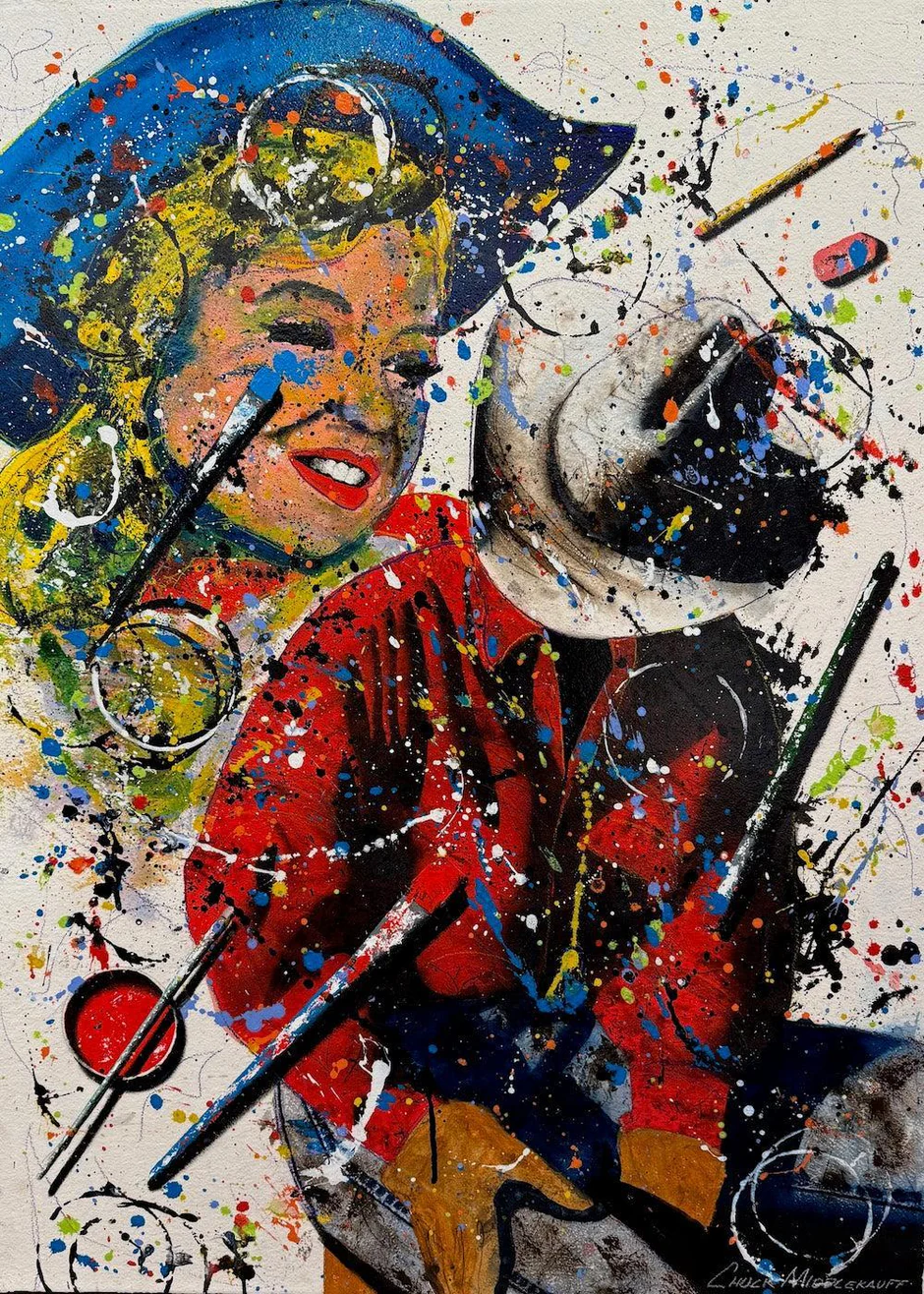
“Last month you told me a cowboy wearing a black hat passing through town had offered to sell you a horse. Cheap. That was a nice story too. Now go fetch firewood for the fireplace. Your grandfather will be home soon.”
The golden bell was never heard of again, though it continues to spark flights of fancy in the ancianos of San Miguel. As for me, what I most remember is the wonder it brought into my six-year-old life.
In Memoriam
Mary Helen Fierro Klare
October 15, 2019
Mary Helen Fierro Klare was a musician, educator, and writer whose life was shaped by a deep love of the arts. A longtime orchestra teacher and performer, she shared her passion for music with students and audiences across the Southwest. Her creative voice extended beyond the concert hall into poetry and prose, reflecting a lifelong devotion to expression and learning. Her contributions continue to echo through the many lives and communities she touched.