
Paul Folwell is a painter. Making art has been a part of his existence since childhood. But in 1965, he came to Durango, Colorado, to serve as the ski patrol director for the then-Purgatory Ski Area (now Durango Mountain Resort). He relocated to Durango following a brief stint working for American Greetings, serving in the Colorado National Guard, and bartending at the Red Ram in Georgetown, Colorado, while working for the ski patrol at Loveland Ski Area. Eventually, he became the Mountain Manager at Purgatory.
His longtime friend and former employee, Don “Dirty” Hinkley, describes their early work laying out new terrain for skiing. “Paul felt that a good ski trail should contain some mystery. What’s down this chute, around the twist, and over this headwall? These questions have enhanced the skier’s experience, and his artistic approach to trail construction has contributed to Purgatory’s unique flavor,” Hinkley says.
“The love of the outdoors is actually why I became a landscape painter primarily,” Folwell said from his studio in Hermosa, a stream running through the back yard, jazz playing softly in the background. “It’s not that I haven’t done other things.”
Folwell studied art and was an early graduate of the Colorado Institute of Art. Abstract Expressionism was, at the time, the most important movement in the art world, and America was patriotically educating all students on the theories established by artists like Clyfford Still, Robert Motherwell, Barnett Newman, Mark Rothko, and Jackson Pollock.
“I did a lot of it [abstraction] at one time,” Folwell says. “Being a landscape painter was passé.”
Until 1974, when Folwell attended Expo ’74 in Spokane, Wash., and saw some photo-realistic paintings. “They were surrealistic in a way that really hit me. I realized it didn’t matter, and I just needed to paint what I wanted. Photorealism became a big thing after that, and that’s when it dawned on me that everything is a trend,” Folwell says.
Folwell primarily paints landscapes that capture the magic and light of alpine vistas, desert expanses, and frigid, frozen lakes. Often simple, perhaps even ordinary, the works capture a moment when the light glimmers off a stream beginning to thaw in spring, or the intense pink hues that seem to radiate from within the Rockies as the last of the sun’s rays reflect off the snow.
“The great thing about being a painter is that sometimes the mundane becomes fascinating if you start looking at something long enough,” he says, sharing a hiking stick he brought back into the studio to paint the intense orange and sage green hues of the lichen and moss on the stick.
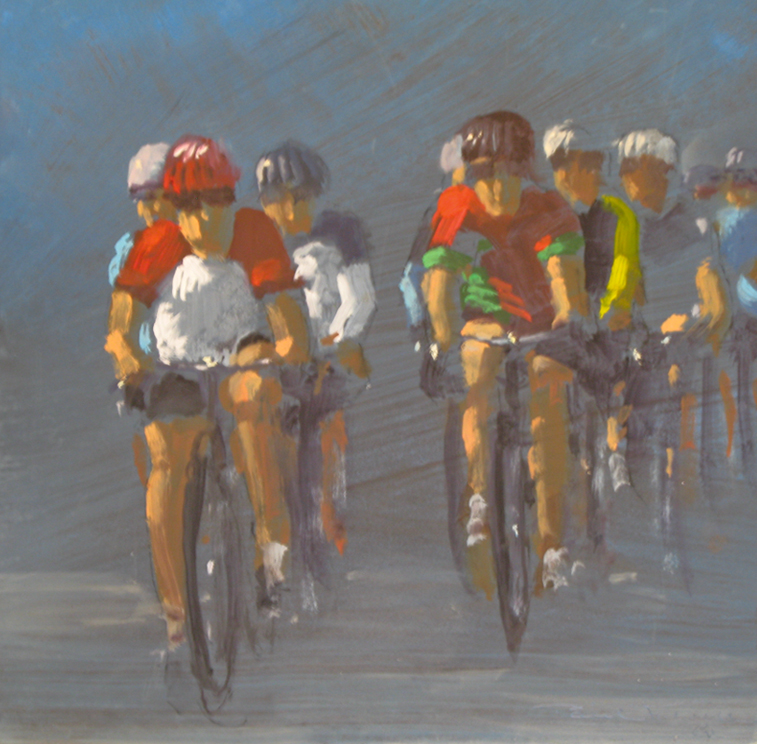
An avid skier and hiker, Folwell understands force, motion, speed, and fluidity. He paints skiers with the expertise of one who’s been there, the deep powder blowing over and around the figure that disappears into the anything but white-ness of the snow. When capturing figures, Folwell goes for motion and movement, not static poses.
“A lot of times I try and sketch the gestures and just let it happen – keep it simple. It’s a way to tell a story but also have the feeling of it, the snow and the temperature,” he says.
Whether a skier, a baseball player sliding into home, a golfer teeing up for a swing, a bicyclist speeding by, or the numerous dancers he sketches in paint, Folwell is all about the mystery.
“What I like in painting is I like the viewer to participate, and I like the viewer to put something into it.”
But whether figures in motion or landscapes, it really is all about the light. Folwell primarily paints with oils for their juiciness and ability to do both washes and thicker, opaque applications. Large and small, his paintings all explore a moment of magic, a moment of mystery, a moment of life fleeting by and captured on panels with paint.